
Why Your Quran Recitation Sounds Monotone (Even When Your Tajweed Is Correct)
SaifTajweed tells you how to pronounce. It says nothing about pitch, and pitch is what the ear hears as beautiful. Four trainable habits close that gap, starting today.
You've heard the gap. You record yourself, or someone recites right after you. Same surah, same rules, and theirs moves while yours sits still. Flat. Even. One long line.
If that's you, nothing is wrong with your voice. You were trained in one system and you're being judged by another.
Tajweed governs accuracy. It has almost nothing to say about your voice.
Tajweed governs what the letters do. Where in the mouth each one is formed. How long to hold a madd. When the sound passes through the nose. Where you are allowed to stop. It is a complete and precise system. For pronunciation.
What it does not govern is pitch. Nowhere in tajweed are you told what note to begin on, whether to rise or fall across a phrase, how loud to be at the start of an ayah compared with the end, or where the phrase should peak. You can recite with flawless tajweed on a single unchanging pitch for twenty minutes. Every rule will be satisfied. It will still sound like reading.
That is the whole problem in one sentence: you were taught accuracy, and you're trying to produce beauty. Two different skills. The second one was never on the syllabus.
Tajweed tells you:
- where each letter is articulated
- the qualities that distinguish one letter from another
- how many counts to hold an elongation
- where nasalisation applies
- where you may stop and where you may not
Tajweed says nothing about:
- what pitch you begin on
- whether your voice rises or falls across a phrase
- how loud you are, and where that changes
- the shape of a phrase, or where it peaks
- how one phrase relates to the one after it
Everything in that second list is voice. It is trainable, it has a method, and almost nobody is taught it.
The four reasons a correct recitation still sounds flat
1. You're reciting at your speaking pitch
Speech sits low in your range and moves within a narrow band: a few notes, no more. That's what speech is for. It's efficient and unremarkable on purpose.
When you open the mushaf and begin, your voice does what it always does. It settles at speaking pitch. The Arabic changes and the rules get applied, but the instrument is still in conversation mode.
Lift the starting pitch even a little and something changes immediately. The voice comes off its speaking setup. The throat opens, the sound rings instead of sitting, and it carries further for less effort. The ear stops hearing a person reading and starts hearing a person reciting, and you haven't learned a single new rule to get there.
Try this now. Hum. Not a performance, just a comfortable closed-mouth hum, the sound you'd make agreeing with someone. Slide it up until you find the spot where it feels easy and you can feel it buzzing in the front of your face. That buzz is a sensation rather than a place you're sending the sound, but it's a reliable sign you've found an efficient setup. That pitch is usually a good deal higher than where you've been starting. Begin an ayah there.
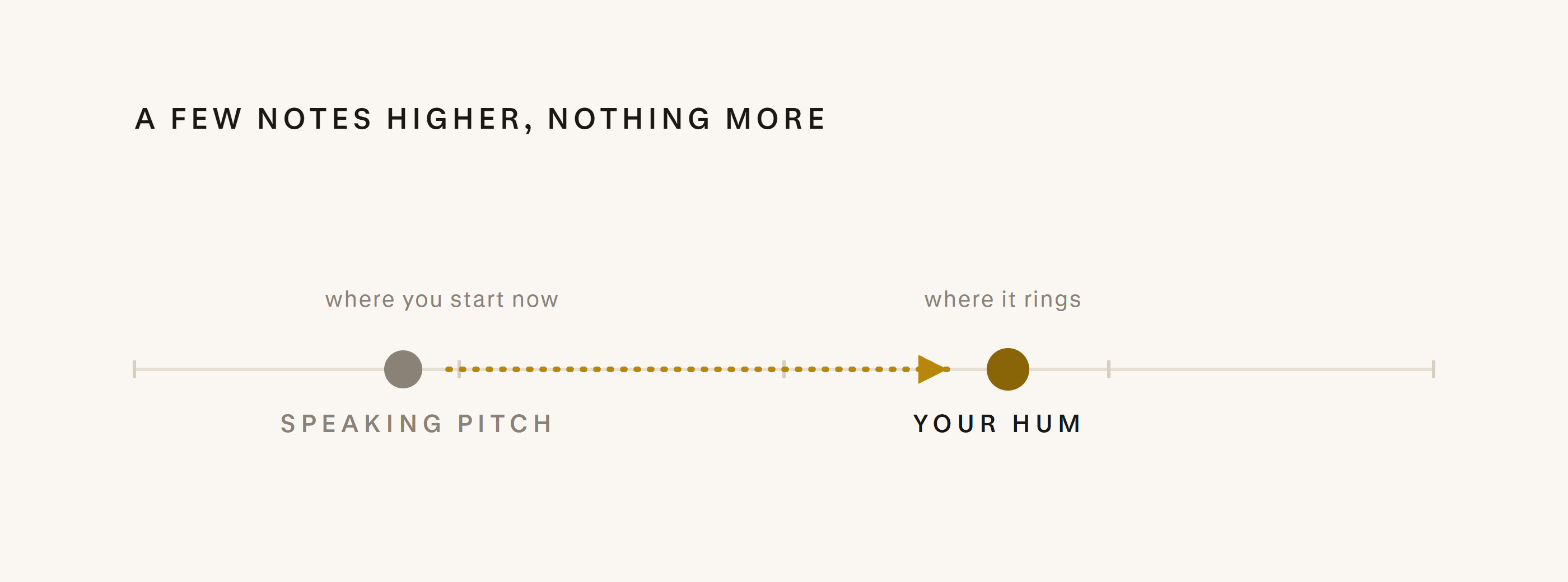
Hear it. Twenty-five seconds of that warmup, from the Foundation course. Listen to how little the pitch moves. Holding one note steady, and feeling where it rings, is the whole exercise.
Most people are surprised how much that alone does.
2. Your attention is already full
Reading Arabic, applying tajweed, and retrieving the next ayah if you're reciting from memory are all demanding at the same time. Pitch is a fourth layer and there's no room for it. So the voice falls back on its default, and the default is flat.
This isn't a talent problem. It's a capacity problem, and the fix is to take the other layers away.
Pick something you know so well you couldn't get it wrong. Al-Fatihah, or one of the short surahs you've recited a thousand times. Recite it with no goal except pitch. Let yourself be completely uninteresting about everything else. You are not working on tajweed right now, you're working on one thing.
Add the layers back once pitch stops needing your attention. That's how every voice skill gets built: one layer at a time, until it runs by itself and frees up room for the next.
3. Your breath dies before the phrase does
Record yourself and count how many phrases end the same way: pitch sagging, volume thinning, the last word smaller than the first.
That isn't a musical choice. That's air running out.
When you start a phrase on a full breath and finish it on the last of your air, there's less pressure under your vocal folds to make sound with. Volume thins out, and pitch tends to follow it down. Some of that is air. Some of it is habit: the voice learns to fall away at the end of a phrase and keeps doing it even when there's air left. Either way, every phrase ends up carrying the identical shape: strong, weaker, gone. Do that for a page and the ear stops registering variation at all. Even when your pitch is moving, the pattern underneath never changes.
The fix isn't more air. It's deciding before you begin where the air is going: how much this phrase needs, where you intend to stop, and how much you're holding in reserve so the final word lands as clearly as the first. That's breath distribution, and it's a planning skill more than a lung-capacity one.
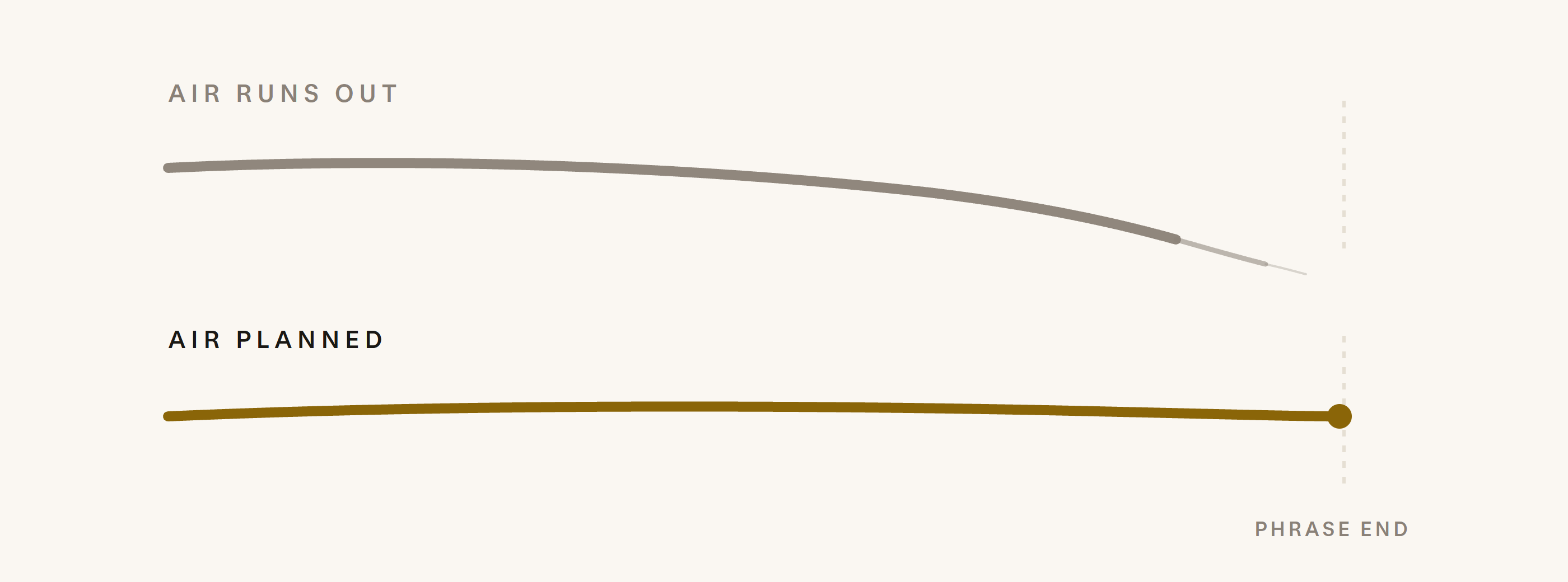
Hear it. Half a minute of breath work, from the Precision course. The longest unbroken phrase in it runs about ten seconds. Listen to what the air is doing underneath rather than to the melody on top.
4. Every phrase gets treated the same
Recitation that moves people is not a string of identical units. The phrases relate to each other. One opens and another answers. One climbs and the next settles. There's an arc across an ayah and a longer arc across a passage: somewhere it's heading, and a release when it arrives.
Monotone recitation has no arc. Every phrase gets the same weight, the same shape, the same starting note, as though the ayah were a list.
Start with pairs. Take two phrases and make the second one answer the first: a little lower, a little more settled. Then try it the other way and let the second one rise. You'll hear straight away which one the meaning wants.
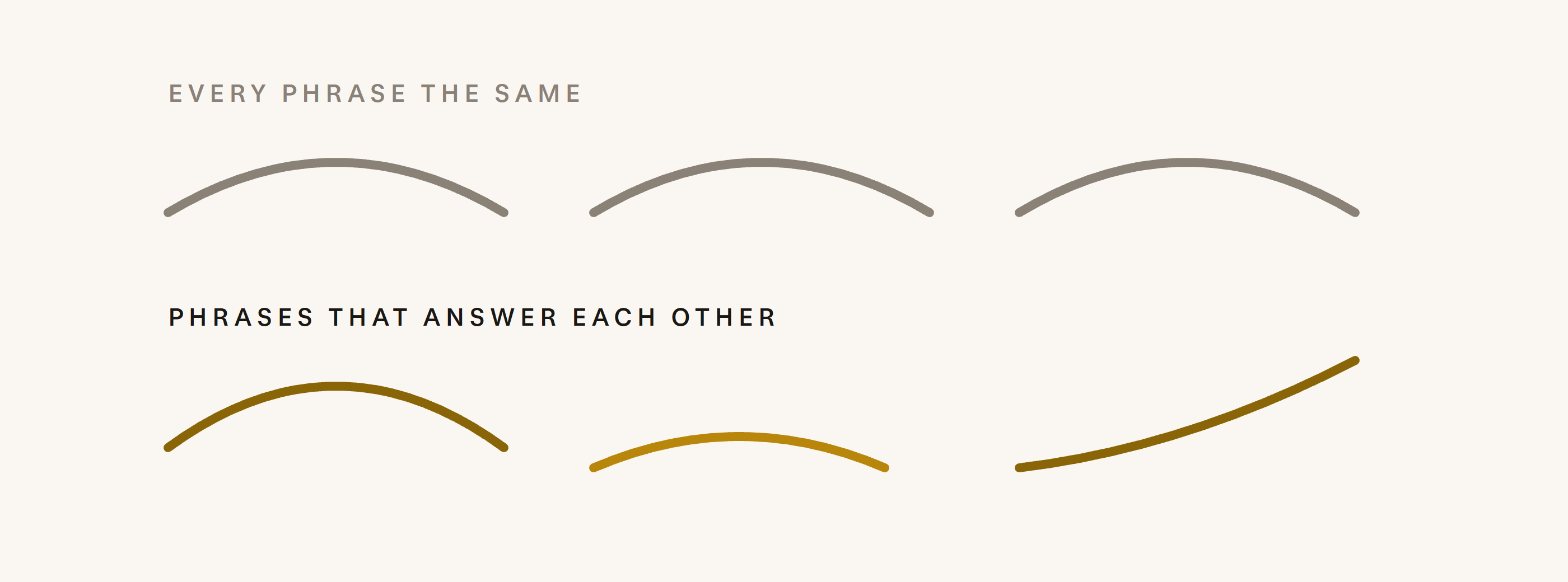
Hear it. Twenty-four seconds from the Precision course. Every phrase is shaped differently from the one before it, and that difference is precisely what a flat recitation is missing.
Why listening to more recitation hasn't fixed it
This is the advice everyone gives. There's a reason it hasn't worked for you.
Listening trains your ear. It does not train your voice. You can develop taste refined enough to hear exactly what a reciter is doing (the shape, the timing, the restraint) and still be unable to produce any of it, because producing it requires your body to do something it has never done.
Anyone who plays an instrument knows this. Listening to a great player doesn't move your hands. Someone has to show you what your hands do.
Listening is necessary. It's how you learn what to aim at. But it's the map, not the walk. If you've been listening for years and nothing has shifted, that isn't evidence you lack talent. It means you've been doing half the work.
And why the maqamat didn't fix it either
Plenty of people arrive at the maqamat expecting them to solve this, and leave disappointed. They learn the scale of Saba. They learn Ajam. They can name them by ear, and their own recitation still sounds exactly like their own recitation.
Here's why. A maqam tells you what to sing: which note it rests on, which one it leans toward, how it tends to move. It tells you nothing about whether your voice can produce those notes cleanly, hold them on steady air, or move between them without a bump. Learning one without the voice underneath it is like being handed sheet music before you can hold the instrument. The notes are right. Everything else is missing.
That's the order that works, and it's the order for a reason. Breath first. Then tone. Then the maqamat. Skip the first two and the third one doesn't take.
If your voice shakes, that's something else
It sits next to monotone often enough to be worth a note, though the cause is different. Nerves push your breathing high into your chest and tighten the small muscles around your voice box at the same time, and a steady tone needs both of those to hold still. Breath is the part you can reach directly, so that is where to start, and the practical version is in the questions at the end of this article.
One thing to rule out first, though. All of that is about a voice that shakes in front of people and steadies when you're alone. If yours shakes in ordinary conversation too (at home, on the phone, when nothing is at stake), that is something else, and no breathing exercise will touch it. There are treatable conditions that produce exactly that symptom, and they need an ENT or a speech-language pathologist rather than a practice routine. Ten minutes with a doctor is worth more than a year of practising through it.
How to hear what your recitation actually sounds like
You can't fix what you can't hear, and you can't hear yourself accurately while you're reciting. Some of what reaches your ears travels through the bones of your skull, and that path favours the lower, fuller part of your sound, so what you're hearing is partly a version nobody else in the room is getting. Your voice really does sound different from the inside.
So record. Phone voice memo, one ayah, no preparation.
The first listen will be uncomfortable. That's universal, and it passes.
Then listen for four specific things rather than a general impression of good or bad:
- Pitch. Does it move, or does it sit? Hum along with your own recording. If the hum barely changes, you have your answer.
- Phrase endings. Do they all fade out the same way?
- Starting notes. Is every phrase beginning on the same pitch?
- The gap. Play a recitation you love straight after your own. Don't compare quality. You'll lose that comparison and learn nothing from it. Compare movement. Where does theirs go that yours doesn't?
That last one is the whole exercise. You're not measuring how far away you are. You're looking for the one specific thing they're doing that you aren't, because that's the thing you can practise this week.
If seeing it is easier than hearing it, there's a free two-minute diagnostic on this site that records a line and draws your pitch on top of a reference clip, so the drift shows up as a shape instead of something you have to catch by ear. No signup.
What to do this week to fix a monotone recitation
None of this needs a teacher, and none of it takes more than ten minutes a day.
- Record one ayah today, before you change anything. You'll want the comparison later.
- Find your hum pitch, and begin every session there instead of at your speaking voice.
- Take one short surah you know cold and recite it attending only to pitch. Let everything else be ordinary.
- Pick a single phrase and practise landing the last word as clearly as the first. That's a breath problem, and it's the fastest audible win on this list.
- Record again on day seven and play the two back to back.
What you're listening for is whether the pitch moves more on the second recording than it did on the first. Not a transformation. A difference. Any at all tells you the thing is trainable, which is the part most people never find out.
Where this goes next
Everything above is diagnosis. It will get you moving, and for some people that's enough to break a long plateau.
The training itself is a longer arc: breath that holds a long ayah steady, the tone work that gives a voice warmth and smoothness, and the pitch control everything else rests on. That's what Foundation of Recitation covers, module by module, in the order that actually builds, and the first lesson is free, so you can hear the approach before deciding anything.
Once the voice underneath is steady, the maqamat stop being theory. Precision of Recitation opens Saba and Ajam, and the Maqam Library lets you hear each one against real reference clips rather than reading a description of it.
Beautiful recitation is a skill, not a talent you're born with. The people who sound the way you want to sound were not handed it. They were taught it, in order, one layer at a time.
Common questions
Why does my recitation sound monotone even though my tajweed is correct?
Because tajweed and voice are separate systems. Tajweed governs articulation, elongation, nasalisation and stopping points: accuracy. It contains no instruction about pitch, dynamics or phrase shape, which is what the ear hears as melody. Correct tajweed on a single unchanging pitch is still correct tajweed, and it will still sound flat.
Can you learn to recite beautifully without a naturally good voice?
Yes. The qualities people describe as a "beautiful voice" (warmth, steadiness, range, control over a long phrase) respond to training far more than almost anyone expects. Warmth in particular is mostly a matter of how you set up your throat, and that is taught. What you don't choose is the instrument: the size of your larynx and the length of your vocal tract set the outer edges of what your voice can sound like. Inside those edges there is far more room than people think, and most never go looking.
Why does my voice shake when I recite in front of people?
Nerves do two things at once: they push your breathing high into your chest, and they tighten the small muscles around your voice box. Between them the tone loses its steadiness. Breath is the part you can get at directly, so start there: exhale fully before you begin, make your out-breath longer than your in-breath, and start quieter and lower than feels natural, because a loud start on a tight throat is what exposes a tremor. One caveat: if your voice shakes in ordinary conversation too, not just under pressure, see a doctor rather than practising through it.
Will learning the maqamat fix a monotone voice?
Not on its own. A maqam gives you notes and melodic habits, but it can't give you the breath to sustain them or the control to move between them cleanly. People who learn the maqamat before the voice underneath usually report that they can identify each maqam by ear and still don't sound the way they hoped. Breath, then tone, then the maqamat.
How long does it take to improve your recitation voice?
Pitch movement is usually the first thing to shift, because it's a habit you can change deliberately rather than a capacity you have to build. That's exactly why recording yourself on day one matters: without it you have nothing to compare against and the early change goes unnoticed. Breath capacity, tone and control are the slower layers, and those run over months. Nobody can put a date on your voice, but the order is dependable, and the cheap win arrives first precisely so it can tell you the rest is available.
