
Why You Run Out of Breath Halfway Through an Ayah (It Isn't Lung Capacity)
SaifLung size barely predicts how long you can hold a phrase. What separates reciters who never seem to run out is where they breathe and how little air they waste on the way, and both of those are trainable.
You know the moment. Four or five words into a long ayah the air is already going, and you can feel that the rest of the phrase is further away than what you've got left. So you push, the sound thins, the last words come out squeezed, and you take a breath somewhere that makes no sense because you had no choice.
Almost every article about breath and Quran recitation tells you to breathe from your belly and build your lungs up. That advice isn't wrong exactly. It's aimed at the wrong thing.
Lung capacity is not what is stopping you
Researchers have measured this directly, comparing how much air people can hold against how long they can hold a sound. The relationship is weak. Across healthy adults, lung capacity accounts for less than a fifth of the difference in how long someone can sustain a tone, and in one small study there was no relationship at all. Trained classical singers, who spend years on breath, mostly do not have bigger lungs than untrained people of the same age and size. What they have is a voice that spends air more slowly.
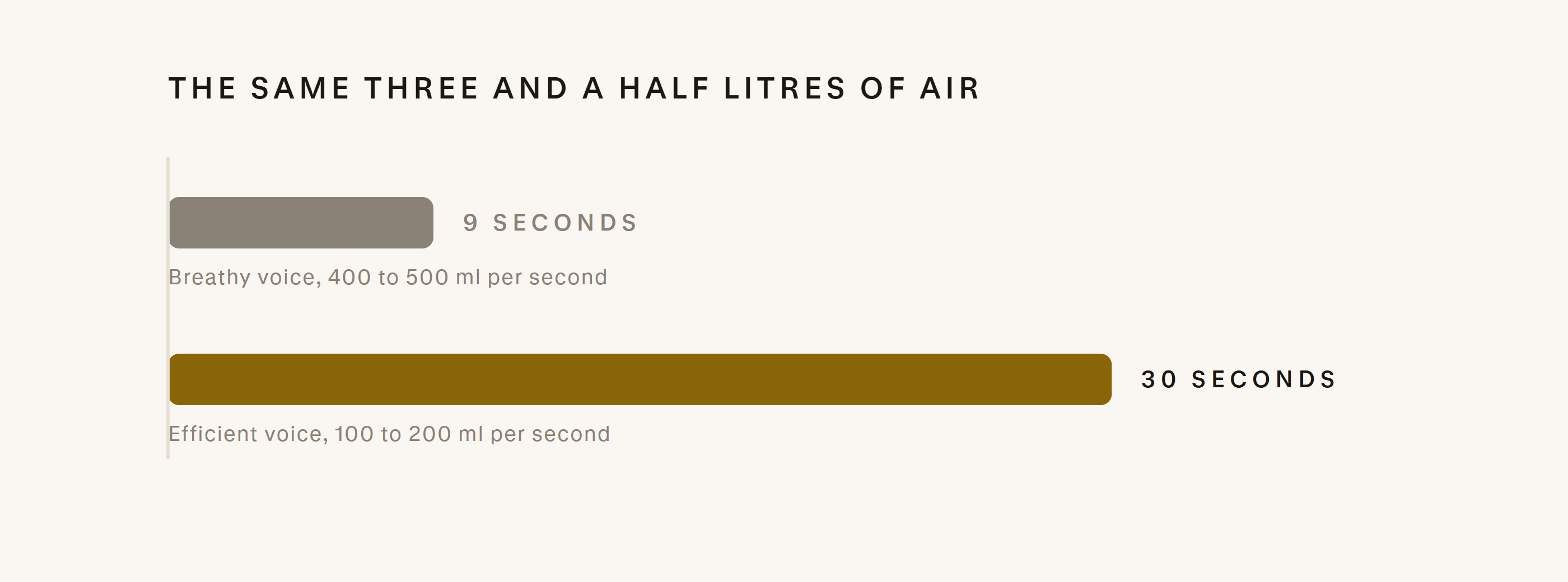
That difference is the actual answer. An efficient voice runs on somewhere around 100 to 200 millilitres of air per second. A breathy, leaky voice can run at 400 to 500. Take a usable three and a half litres or so, spend it efficiently, and you can get past twenty seconds of sound. Spend it at the leaky rate and the same lungs give you about eight.
Nobody's going to grow their lungs three times bigger. Everybody can stop leaking.
The four reasons you run out of breath halfway through an ayah
They're different problems with different fixes, and most people are dealing with two of them at once. Work out which are yours before you practise anything.
1. You are leaking air rather than running out of it
Sound is made by air passing through vocal folds that come together. When they close cleanly, a little air makes a lot of sound. When they stay slightly apart, the extra air rushes through without becoming anything you can hear. A leaky voice sounds breathy rather than ringing, it needs more push to carry, and it thins out fast at the end of a phrase.
Test: this one takes twenty seconds. Take a normal breath and hold a long sss, timing it. Rest, then take the same breath and hold a long zzz, timing that. The two use nearly the same amount of air, except that the zzz uses your voice. If your zzz comes out much shorter, roughly a third shorter or worse, air is probably escaping when your voice turns on. No amount of extra lung will fill a bucket with a hole in it.
What helps is the opposite of pushing. Start a phrase quieter than feels natural and let the sound ring rather than blowing it. Find the pitch where a comfortable hum buzzes in the front of your face and start there, because your voice closes most efficiently in that part of your range. Then keep the volume level instead of leading with a loud first word, which is what empties most people before the halfway mark.
Hear it. Thirty-three seconds from the Foundation course, the breathing module. It's two phrases with one breath in the middle. The first runs a little over thirteen seconds, the second over sixteen, and the second one is the longer of the two. Listen to how quiet the sound stays and how little effort it seems to take.
2. You did not decide where to breathe before you started
This is the big one, and it's the thing almost nobody teaches.
When people read a written text aloud, their breaths land in sensible places. In one study of healthy adults, about three quarters of all breath pauses fell at major boundaries in the sentence, and barely one percent landed somewhere unrelated to the structure. Reading from a page, under two percent of breaths were misplaced. In unplanned speech, that figure was thirteen percent.
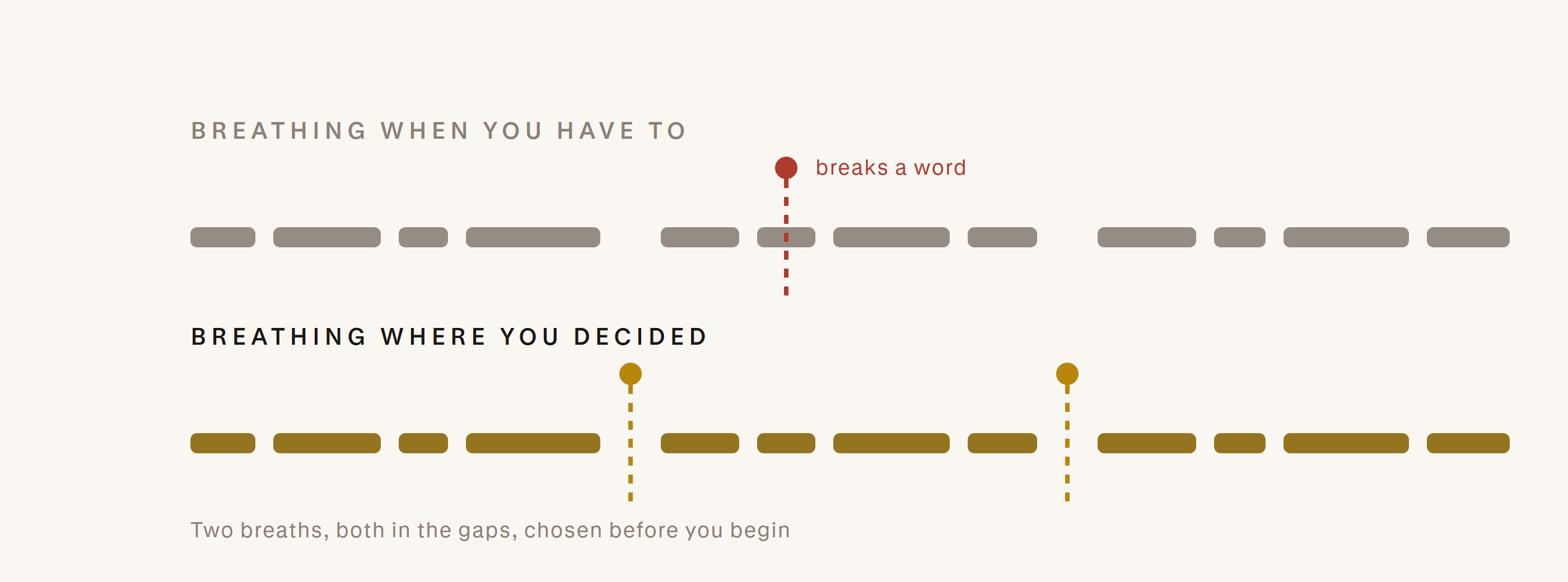
The difference between those two numbers is planning. When you can see what is coming, you breathe ahead of it. When you can't, you breathe when your body makes you.
Researchers have watched the planning happen. People about to say a long sentence took a measurably longer breath first than people about to say a short one. That held even when the experiment controlled how much air they had available. The breath was being sized to a phrase that had not been spoken yet. Children develop this gradually and are not adult-like at it until around the age of twelve, which suggests it is learned rather than something you either have or do not.
Now think about what you are doing with a long ayah. You are reading or recalling a phrase whose length you already know, and you are still breathing reactively, the way you would in unplanned conversation. The information is right there and you're not using it.
Test: record yourself on a long ayah and listen for where the breaths actually landed. If any of them fell in the middle of a word, or somewhere you would never choose on purpose, this one is yours.
Here's the shift, and it's a change in when you think rather than how you breathe. Before you begin, look at the whole ayah and decide where your breaths will go. Not where you might stop if you have to. Where they are going. Two breaths you chose beforehand will always sound better than one heroic breath that collapses.
So what makes a good breath point? Three things, in order of how easy they are to apply:
- Never inside a word. This is the only absolute on the list, and it's the one most often broken when you're breathing reactively.
- Where a thought finishes rather than where your air does. The stop marks printed in your mushaf are placed for the sense of the words, and they show you where the meaning completes. They are not placed for your lungs, so a plan made in advance can work with them and a breath taken in a panic cannot.
- Where you would pause anyway if you were explaining it. If you're unsure and your Arabic isn't strong enough to feel the sense boundaries yet, say the meaning aloud in your own language and notice where you naturally stop. Those places are usually right.
Then do it in writing. Take one long ayah you recite often and mark the two or three places you intend to breathe. Recite it that way ten times, in the same places every time, until you stop having to think about it. That's one ayah handled permanently, and the habit transfers to the next one.
3. You fill to the top, then finish on empty
Both ends of that sentence cost you.
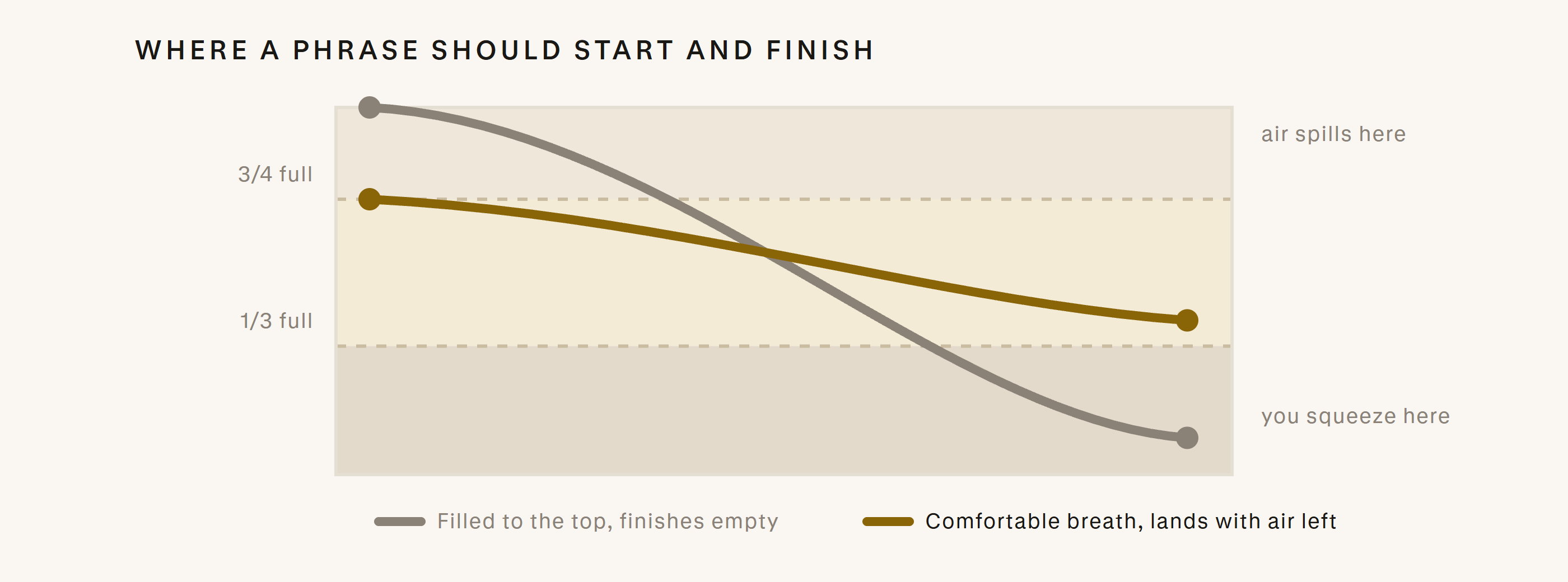
Filling all the way up feels like preparation and behaves like waste. At very high lung volumes the downward pull on your windpipe tends to hold your vocal folds slightly apart, so more air slips through before the sound gets going. The first second of an over-filled phrase is the most expensive second in it.
Test: listen to the last three words of each phrase in your recording. If they tighten, sag in pitch, or sound like effort while the first three did not, you are finishing below the line.
The bottom end is worse. There is a crossover a bit under forty percent of your capacity. Above it, your ribcage and lungs are recoiling outward on their own and your job is mostly to release that pressure at the right rate. Below it the free push is gone and you have to squeeze air out with muscle. That's where the tone tightens, the pitch sags and the last three words sound like work, because they are. The phrase doesn't fail at the end by accident. It fails there because that's where you crossed into pushing.
The correction is unglamorous. Take a comfortable breath rather than a maximum one, around three quarters of what you could take, and plan to finish with something still in reserve rather than on your last drop. A phrase that lands with air left sounds finished. A phrase that lands empty sounds like it ran out, and listeners hear the difference even when they can't name it. In one study people could reliably tell a sentence had been read on too little air, and they were better at spotting that than at spotting an over-filled one.
4. Your pace is set by the text instead of by your air
Speed and breath are connected more tightly than most people realise. When people speak at a comfortable rate, their breaths land at the boundaries of what they are saying. When they are pushed to speak fast, that structure collapses and the need for air becomes the only thing deciding where they pause.
Which describes exactly what happens when you rush a long ayah. Going faster doesn't get you to the end of the phrase before the air runs out. It removes your ability to choose where the breath goes, so the breath lands wherever your body demands it, usually in the worst possible place.
Test: recite the same ayah twice, once as usual and once noticeably slower, and count your breaths in each. If the slower version needs fewer breaths, not more, your pace was the problem.
Slowing down isn't a compromise for people with small lungs. It's what makes a plan possible at all.
What to do when your air runs out in the middle of an ayah
Everything above is prevention. Sometimes you misjudge it anyway, and this is the part nobody writes about.
Take the breath. Don't try to finish the phrase on nothing, because a phrase finished on nothing is louder evidence of a breath problem than a clean pause ever is. The tone goes tight, the pitch drops, and it draws far more attention than a breath would have.
Take it well, which mostly means an open mouth and a relaxed jaw. Gasping noise comes from pulling air fast through a narrow opening. Research on the sounds people make between phrases points at exactly two culprits: how open the jaw is, and how fast the inhalation is. Through the nose is quieter and gentler on your voice but slower, because your nose accounts for at least half the resistance in your whole airway. So use a quick open-mouthed breath for a mid-phrase catch and a nose breath in the longer gaps.
And don't be embarrassed by an audible breath. Listeners use the sound of a breath as a signal that a phrase is starting, and in testing they understood sentences better when the breath was left in. A breath isn't a mistake. A breath in the wrong place is.
How to measure your own breath in two minutes
Almost every article on this subject tells you to hold your breath for thirty, forty, fifty seconds. That measures how long you can hold your breath. It doesn't measure how long you can make sound, and making sound is the thing that spends the air.
Measure what you actually do. Three numbers, one phone, two minutes.
- Your sustained tone. Take a comfortable breath and hold a steady aah at an easy pitch for as long as it stays clean. Most healthy adults land somewhere between about fifteen and thirty seconds. This is your ceiling on one breath, and it's a starting number, not a verdict.
- Your leak. The sss and zzz test from earlier. Divide the sss time by the zzz time. Near one is efficient. Much above that suggests air is escaping when the voice turns on.
- Your real phrases. Record a minute of your Quran recitation, then play it back with a stopwatch and time your actual phrases, start of sound to start of breath. This is the number that matters, and hardly anyone knows their own.
For scale: when adults read ordinary text aloud, their breath groups average about three and a half seconds. Recitation asks for far longer, which is the real reason your everyday breathing habits fail the moment you open the mushaf. You are running a task at four or five times the demand the habit was built for.
We measured our own course clips the same way, because as far as we can tell nobody's published measurements of recitation phrase lengths at all. In the Precision clip below, four phrases run about three and a half, eight, seven and a half, and ten and a half seconds, and the breaths between them get shorter even as the phrases get longer overall. That's a plan working. The air is going into the phrases rather than into the recovery.
Hear it. Thirty-four seconds of breath work from the Precision course. Watch a clock and time the last phrase against the first.
A longer piece shows it more clearly. The adhan clip below runs just under two minutes: six phrases, five breaths, phrases between roughly fourteen and seventeen seconds each, which is four to five times a normal reading breath group. And the longest phrase in the whole recitation is the last one. That's what distribution means in practice. Nothing was spent early that was needed later.
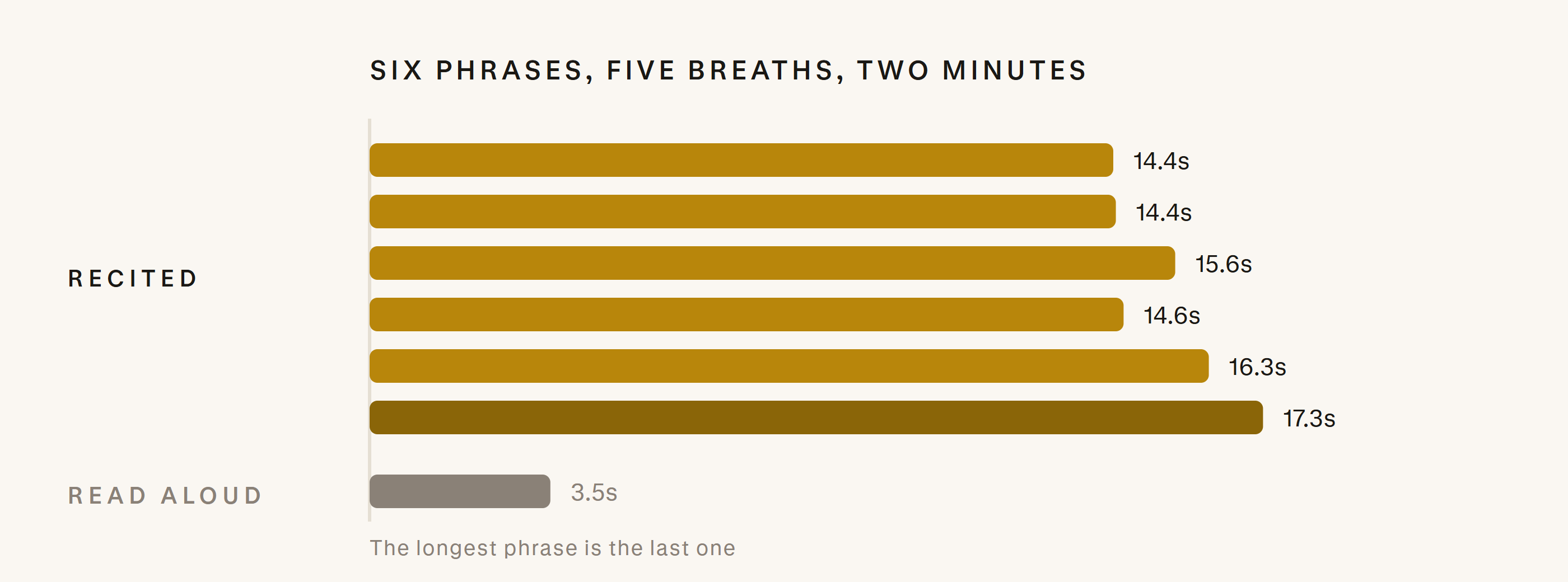
Hear it. Just under two minutes from the Mastery course, the adhan module. You don't need to listen to all of it. Listen to the first phrase, then skip to the last one and compare them.
Why belly breathing, breath holds and swimming have not fixed it
These are the three things you've already been told, so it is worth being specific about what each one is and is not.
Belly breathing is real and worth learning. Breathing low rather than high in your chest gives you a steadier supply and less neck tension. What it doesn't do is tell you where to put the breaths, which is the part that fails you in a long ayah. Voice researchers have said it plainly: gentle diaphragmatic exercises on their own are unlikely to be demanding enough to change what your voice does under load.
Breath-hold drills train breath holding. When you hold your breath your vocal folds are shut and nothing's being spent. When you recite, air passes through them continuously and the whole skill is in the rate.
Cardio and swimming improve your fitness, which is worth having. But the transfer to your voice is weak, because breath control for phonation is a coordination skill between your breathing and your voice, and coordination is specific to the task you practise. If you want a longer recited phrase, the practice has to involve making sound.
What the best evidence in this area actually points at is what this article has been describing. In a controlled trial, people whose voices felt tight and effortful were trained on where in their air supply to start and stop phrases. In a few weeks the changes were large, and the effort they reported dropped by about a third. It is one trial with a small group, but it is the one that trained the right thing. Nobody trained their lungs. They trained the plan.
What to do this week to recite longer phrases on one breath
Ten minutes a day, no equipment, no teacher required.
- Take your three measurements today and write them down. Sustained aah, the sss to zzz ratio, and your real phrase lengths off a recording. You can't see progress you never baselined.
- Pick one long ayah and mark your breath points in advance. Two or three, chosen for the sense of the phrase, and the same ones every time.
- Recite it at three quarters of your usual speed. Slow enough that the plan survives contact with the phrase.
- Start quieter than feels right, at your hum pitch, and keep the volume level instead of leading loud. Most of your air is lost in the first two seconds.
- Aim to finish every phrase with air still in reserve. If you land empty, your breath point was in the wrong place. Move it and go again.
- Record the same ayah on day seven and time the phrases against your first recording.
What you're looking for on day seven isn't a dramatic change. It's one or two seconds more per phrase and endings that don't sag. That's enough to tell you the thing responds to training, which is the part most people never find out, because they were practising breath holds instead.
When it is not a technique problem
Most breath trouble in recitation is habit and planning. Some of it isn't, and it's worth knowing the difference rather than practising through something that needs a different kind of help.
See a doctor rather than a voice coach if any of these apply. You get out of breath during ordinary activity and not only when reciting. You've been hoarse for more than two or three weeks. Your voice tires or fades badly after short use. You can't sustain a steady tone for even ten seconds. Asthma, reflux, allergies and thyroid conditions all show up as breath and voice complaints, and vocal folds that are not closing properly are often treatable once someone looks at them.
People who recite daily, lead prayers or call the adhan are professional voice users in every sense that matters, and the research on religious officials finds they get less voice training and more voice trouble than comparable groups. That's a reason to take a persistent symptom seriously, not to push harder through it. Nothing here is medical advice.
Where this goes next
If you take one idea from this, take the second cause. Deciding your breaths before you begin costs nothing, it works this week, and it's the single thing separating the recitation you hear in your head from the one coming out of your mouth.
Beyond that it's ordinary skill building. Foundation of Recitation covers the breathing work and the tone work that makes a voice efficient in the first place, in the order that builds. The first lesson is free, so you can hear the approach before deciding anything. Precision of Recitation has a module devoted to breath distribution, which is the planning skill above taken as far as it goes.
And if your phrases still sound flat once the air is behaving, that's a separate problem with a separate fix, covered in why your recitation sounds monotone even when your tajweed is correct. There is also a free two-minute diagnostic here that records a line and draws your pitch, which is usually the quickest way to see a phrase sagging at the end rather than trying to catch it by ear.
Running out of air halfway through an ayah isn't a verdict on your lungs or your voice. It's a plan you were never given.
Common questions
How do reciters recite long verses without running out of breath?
Not by having unusually large lungs. Lung capacity explains less than a fifth of the difference in how long people can sustain sound, and trained singers mostly do not have bigger lungs than anyone else. What they have is an efficient voice that spends air slowly, and a breath plan decided before the phrase starts. Measured on our own course recordings, phrases of fourteen to seventeen seconds are what a trained voice produced, against about three and a half seconds for an adult reading text aloud normally. Worth adding: nobody has published measurements of famous reciters' phrase lengths, so treat any specific claim about a particular reciter as a story rather than a number.
Why am I fine reading quietly but out of breath when I recite aloud?
Because they're different tasks for your breathing. At rest you spend about forty percent of the cycle breathing in and sixty breathing out, using around a tenth of your capacity, and reading silently barely disturbs that. Speaking or reciting flips it, with roughly ten percent of the time spent breathing in and ninety spent letting air out through a voice that needs pressure behind it. Your inhalations have to shrink from about two seconds to well under one, and everything you produce has to run on a controlled release. Being comfortable at rest tells you very little about how you'll do under that load.
How do I make my breath last longer when reciting?
In this order. First stop leaking, by starting quieter and letting the sound ring rather than pushing it, since a breathy voice can spend air roughly three times faster than an efficient one. Second, decide your breath points before you start the ayah instead of breathing when your body demands it. Third, take a comfortable breath rather than a maximum one and plan to finish with something in reserve. Fourth, slow down, because a fast pace takes away your ability to choose where the breath falls. Lung training belongs a long way down that list, if at all.
Does holding your breath longer help your Quran recitation?
Very little. Breath holding is a different task from making sound: when you hold your breath your vocal folds are closed and no air is being spent, while reciting is a continuous controlled release through a working voice. The training that has actually been shown to help taught people where in their air supply to begin and end a phrase, and in that trial it produced large improvements along with a substantial drop in how effortful speaking felt. Practise the release, not the hold.
What should I do if I run out of air in the middle of an ayah?
Take the breath rather than forcing the rest of the phrase out on nothing, because a squeezed ending is more noticeable than a pause. Take it with your mouth open and your jaw relaxed, which is what makes a breath quiet: noisy inhalation comes from pulling air quickly through a narrow opening. An audible breath isn't a failure in any case, since listeners use the sound of a breath as a cue that a new phrase is beginning. Afterwards, work out where you should have breathed and mark it, so the same phrase doesn't catch you twice.
How long does it take to improve breath control in recitation?
The planning half changes almost immediately, because deciding your breath points in advance is a decision rather than a capacity. Most people hear a difference in their first session. Efficiency, the part that stops you leaking air, takes longer, and the controlled trials in this area run over weeks. Capacity and tone are slower still and run over months. Measure your phrase lengths on day one and again on day seven, and expect a second or two rather than a transformation. A second or two is the evidence that the rest is available.
